
Investigation of a Collision
As the collision litigation evolves it will be important for the Attorney involved to keep each of these interests advised of significant developments, and to seek their approval to any major step, such as a choice of venue for the litigation or the terms of any proposed settlement.
In the immediate aftermath of a collision there are many important arrangements to be made, these arrangements will certainly be the job of the Attorney to coordinate. Such arrangements will include conducting surveys, providing security, collecting all relevant documents and taking statements from the witnesses.
Surveys are conducted covering the damage suffered by the client ship as a result of the collision, the damage suffered by the other party’s ship as a result of the collision (without prejudice to liability). Another important survey concerns the facts of the collision including the speed and angle of blow and the actions of both ships prior to it.
A letter of guarantee is usually issued by the P&I (Protection & Indemnity) Club of the ship concerned to guarantee payment of whatever damages are due and payable at the conclusion of the litigation.
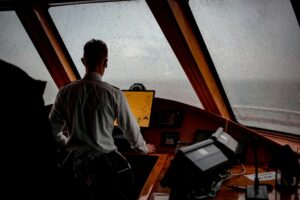
Following a major accident such as a collision at sea it is imperative that the facts should be established with reasonable certainty as quickly as possible. The lawyer con ducting such an investigation, usually a solicitor or an experienced legal executive, must assemble all the ship’s documents including log books, charts and any automatic data logging devices installed on the ship. They will then interview the officers and crew members on watch on the bridge and in the engine room, and any other member of the crew who witnessed anything relevant, and prepare a written statement of each wit ness’s evidence. These are privileged statements meaning the statements cannot be forcibly disclosed to the other parties to the litigation without the agreement of the party on whose behalf they were made. In practice, most such statements are disclosed in English collision proceedings and treated as evidence of the facts described, except where the witness is called to give oral evidence.
Independent Evidence
Such evidence is always of considerable value in a collision case, but it is not always easy to obtain. The Speed and Angle of Blow Survey Report is in a sense independent, since it is based on the crumpled metal of both ships, but it is always also an expression of professional opinion, albeit one of an experienced engineer surveyor. Better evidentiary value will be given by, for example, a videotape recording of the radar showing movements of the ships concerned made by an official body such as Dover Coast guard or other Vessel Traffic Surveillance (VTS) service. The rapid action of the Attorney to preserve recordings is of paramount importance.
Occasionally, independent evidence may be obtained from the officer on watch on another ship in the vicinity of the collision, who may have observed the movements of the two ships on radar. Although discovering the existence of such evidence might be difficult, the wise practitioner is well advised to spend time, and if necessary, money, to follow up these enquiries, since the value of such independent evidence can be extremely significant.
Add comment